
期刊文章
过刊浏览
- Volumes 108-119 (2025)
-
Volumes 96-107 (2025)
-
Volume 107
Pages 1-376 (December 2025)
-
Volume 106
Pages 1-336 (November 2025)
-
Volume 105
Pages 1-356 (October 2025)
-
Volume 104
Pages 1-332 (September 2025)
-
Volume 103
Pages 1-314 (August 2025)
-
Volume 102
Pages 1-276 (July 2025)
-
Volume 101
Pages 1-166 (June 2025)
-
Volume 100
Pages 1-256 (May 2025)
-
Volume 99
Pages 1-242 (April 2025)
-
Volume 98
Pages 1-288 (March 2025)
-
Volume 97
Pages 1-256 (February 2025)
-
Volume 96
Pages 1-340 (January 2025)
-
Volume 107
-
Volumes 84-95 (2024)
-
Volume 95
Pages 1-392 (December 2024)
-
Volume 94
Pages 1-400 (November 2024)
-
Volume 93
Pages 1-376 (October 2024)
-
Volume 92
Pages 1-316 (September 2024)
-
Volume 91
Pages 1-378 (August 2024)
-
Volume 90
Pages 1-580 (July 2024)
-
Volume 89
Pages 1-278 (June 2024)
-
Volume 88
Pages 1-350 (May 2024)
-
Volume 87
Pages 1-338 (April 2024)
-
Volume 86
Pages 1-312 (March 2024)
-
Volume 85
Pages 1-334 (February 2024)
-
Volume 84
Pages 1-308 (January 2024)
-
Volume 95
-
Volumes 72-83 (2023)
-
Volume 83
Pages 1-258 (December 2023)
-
Volume 82
Pages 1-204 (November 2023)
-
Volume 81
Pages 1-188 (October 2023)
-
Volume 80
Pages 1-202 (September 2023)
-
Volume 79
Pages 1-172 (August 2023)
-
Volume 78
Pages 1-146 (July 2023)
-
Volume 77
Pages 1-152 (June 2023)
-
Volume 76
Pages 1-176 (May 2023)
-
Volume 75
Pages 1-228 (April 2023)
-
Volume 74
Pages 1-200 (March 2023)
-
Volume 73
Pages 1-138 (February 2023)
-
Volume 72
Pages 1-144 (January 2023)
-
Volume 83
-
Volumes 60-71 (2022)
-
Volume 71
Pages 1-108 (December 2022)
-
Volume 70
Pages 1-106 (November 2022)
-
Volume 69
Pages 1-122 (October 2022)
-
Volume 68
Pages 1-124 (September 2022)
-
Volume 67
Pages 1-102 (August 2022)
-
Volume 66
Pages 1-112 (July 2022)
-
Volume 65
Pages 1-138 (June 2022)
-
Volume 64
Pages 1-186 (May 2022)
-
Volume 63
Pages 1-124 (April 2022)
-
Volume 62
Pages 1-104 (March 2022)
-
Volume 61
Pages 1-120 (February 2022)
-
Volume 60
Pages 1-124 (January 2022)
-
Volume 71
- Volumes 54-59 (2021)
- Volumes 48-53 (2020)
- Volumes 42-47 (2019)
- Volumes 36-41 (2018)
- Volumes 30-35 (2017)
- Volumes 24-29 (2016)
- Volumes 18-23 (2015)
- Volumes 12-17 (2014)
- Volume 11 (2013)
- Volume 10 (2012)
- Volume 9 (2011)
- Volume 8 (2010)
- Volume 7 (2009)
- Volume 6 (2008)
- Volume 5 (2007)
- Volume 4 (2006)
- Volume 3 (2005)
- Volume 2 (2004)
- Volume 1 (2003)
Volume 117
Theoretical criteria for particle size distribution of high compacted density LiFePO4 based on packing density modeling
Jinshun Lei a, Huanfeng Huang b, Lv Zhang a, Dewen Zeng a *, Zhongwei Zhao c
a College of Chemistry and Chemical Engineering, Central South University, Changsha, 410083, China
b Guangdong Guanghua Sci-Tech Co. Ltd, Shantou, 515061, China
c School of Metallurgy and Environment, Central South University, Changsha, 410083, China
10.1016/j.partic.2026.08.017
Volume 117,
October 2026,
Pages 524-533
Received 1 July 2026, Revised 13 August 2026, Accepted 15 August 2026, Available online 17 August 2026, Version of Record 26 August 2026.
E-mail:
dewen_zeng@hotmail.com
Highlights
• Packing model links PSD to LFP compacted density.
• Model predictions agree with experimental trends.
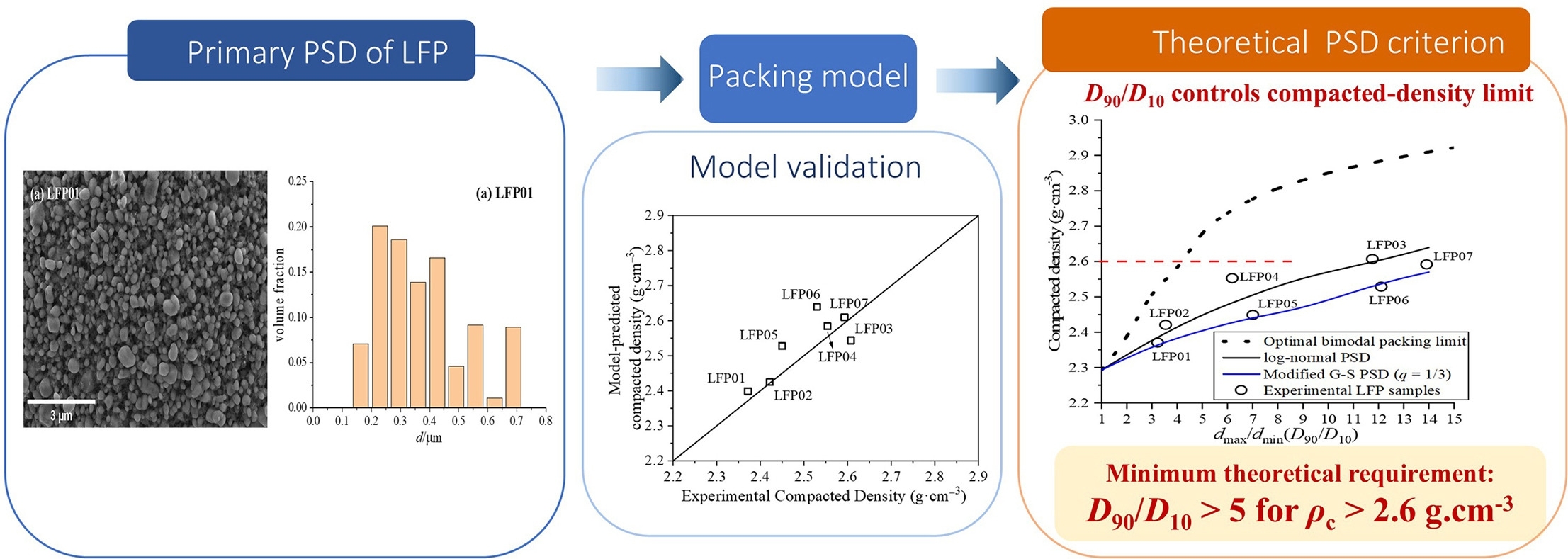
• Theoretical compacted-density limits are defined by PSD span.
• D90/D10 > 5 is required for compacted density above 2.6 g cm−3.
Abstract
Compacted density can be effectively improved by optimizing the particle size distribution (PSD) of LiFePO4 (LFP) materials. However, high-density LFP materials are still mainly developed through experimental trial-and-error approaches, and the quantitative relationship between PSD characteristics and compacted density remains unclear. As a result, the minimum theoretical PSD requirements for achieving a target compacted density remain unclear. In this work, seven LFP samples with different PSD characteristics were prepared. A packing density model was employed to predict their compacted densities. The predictions agree well with experimental measurements, demonstrating the reliability and applicability of the model for LFP systems. Based on the model, theoretical criteria for high-density LFP materials are systematically identified. The results indicate that: (1) the maximum achievable compacted density is primarily controlled by the particle size span D90/D10, with larger values leading to higher upper limits; (2) for an LFP system with fixed D90 and D10, the maximum compacted density is uniquely determined and cannot be exceeded by varying the distribution in the intermediate size range (D20–D80); and (3) D90/D10 > 5 represents the minimum theoretical requirement for achieving a compacted density above 2.6 g cm−3 in LFP materials.
Graphical abstract
Keywords
LiFePO4 materials; Compacted density; Particle size distribution; Packing density model
文章导读