
期刊文章
过刊浏览
- Volumes 108-119 (2025)
-
Volumes 96-107 (2025)
-
Volume 107
Pages 1-376 (December 2025)
-
Volume 106
Pages 1-336 (November 2025)
-
Volume 105
Pages 1-356 (October 2025)
-
Volume 104
Pages 1-332 (September 2025)
-
Volume 103
Pages 1-314 (August 2025)
-
Volume 102
Pages 1-276 (July 2025)
-
Volume 101
Pages 1-166 (June 2025)
-
Volume 100
Pages 1-256 (May 2025)
-
Volume 99
Pages 1-242 (April 2025)
-
Volume 98
Pages 1-288 (March 2025)
-
Volume 97
Pages 1-256 (February 2025)
-
Volume 96
Pages 1-340 (January 2025)
-
Volume 107
-
Volumes 84-95 (2024)
-
Volume 95
Pages 1-392 (December 2024)
-
Volume 94
Pages 1-400 (November 2024)
-
Volume 93
Pages 1-376 (October 2024)
-
Volume 92
Pages 1-316 (September 2024)
-
Volume 91
Pages 1-378 (August 2024)
-
Volume 90
Pages 1-580 (July 2024)
-
Volume 89
Pages 1-278 (June 2024)
-
Volume 88
Pages 1-350 (May 2024)
-
Volume 87
Pages 1-338 (April 2024)
-
Volume 86
Pages 1-312 (March 2024)
-
Volume 85
Pages 1-334 (February 2024)
-
Volume 84
Pages 1-308 (January 2024)
-
Volume 95
-
Volumes 72-83 (2023)
-
Volume 83
Pages 1-258 (December 2023)
-
Volume 82
Pages 1-204 (November 2023)
-
Volume 81
Pages 1-188 (October 2023)
-
Volume 80
Pages 1-202 (September 2023)
-
Volume 79
Pages 1-172 (August 2023)
-
Volume 78
Pages 1-146 (July 2023)
-
Volume 77
Pages 1-152 (June 2023)
-
Volume 76
Pages 1-176 (May 2023)
-
Volume 75
Pages 1-228 (April 2023)
-
Volume 74
Pages 1-200 (March 2023)
-
Volume 73
Pages 1-138 (February 2023)
-
Volume 72
Pages 1-144 (January 2023)
-
Volume 83
-
Volumes 60-71 (2022)
-
Volume 71
Pages 1-108 (December 2022)
-
Volume 70
Pages 1-106 (November 2022)
-
Volume 69
Pages 1-122 (October 2022)
-
Volume 68
Pages 1-124 (September 2022)
-
Volume 67
Pages 1-102 (August 2022)
-
Volume 66
Pages 1-112 (July 2022)
-
Volume 65
Pages 1-138 (June 2022)
-
Volume 64
Pages 1-186 (May 2022)
-
Volume 63
Pages 1-124 (April 2022)
-
Volume 62
Pages 1-104 (March 2022)
-
Volume 61
Pages 1-120 (February 2022)
-
Volume 60
Pages 1-124 (January 2022)
-
Volume 71
- Volumes 54-59 (2021)
- Volumes 48-53 (2020)
- Volumes 42-47 (2019)
- Volumes 36-41 (2018)
- Volumes 30-35 (2017)
- Volumes 24-29 (2016)
- Volumes 18-23 (2015)
- Volumes 12-17 (2014)
- Volume 11 (2013)
- Volume 10 (2012)
- Volume 9 (2011)
- Volume 8 (2010)
- Volume 7 (2009)
- Volume 6 (2008)
- Volume 5 (2007)
- Volume 4 (2006)
- Volume 3 (2005)
- Volume 2 (2004)
- Volume 1 (2003)
Volume 117
Development of a positron emission particle tracking system (Open Access)
Yannick Hartych *, Nadia Böhle, Mario Fink, Miriam Fritsch, Fritz-Herbert Heinsius, Thomas Held, Tobias Holtmann, Moritz Huckestein, Josephine Oppotsch, Marc Pelizäus, Matthias Steinke, Esther Constanze Wais, Ulrich Wiedner
Institute of Experimental Hadron Physics, Ruhr University Bochum, Universitätsstr. 150, 44801 Bochum, Germany
10.1016/j.partic.2026.08.002
Volume 117,
October 2026,
Pages 542-549
Received 1 December 2025, Revised 20 July 2026, Accepted 3 August 2026, Available online 14 August 2026, Version of Record 27 August 2026.
E-mail:
yhartych@ep1.rub.de
Highlights
• Mounting of a PEPT detector system.
• Detector commissioning.
• Detailed description of signal processing chain.
• Comprehensive presentation of data evaluation.
• Comparison of measured data with previously published simulations.
Abstract
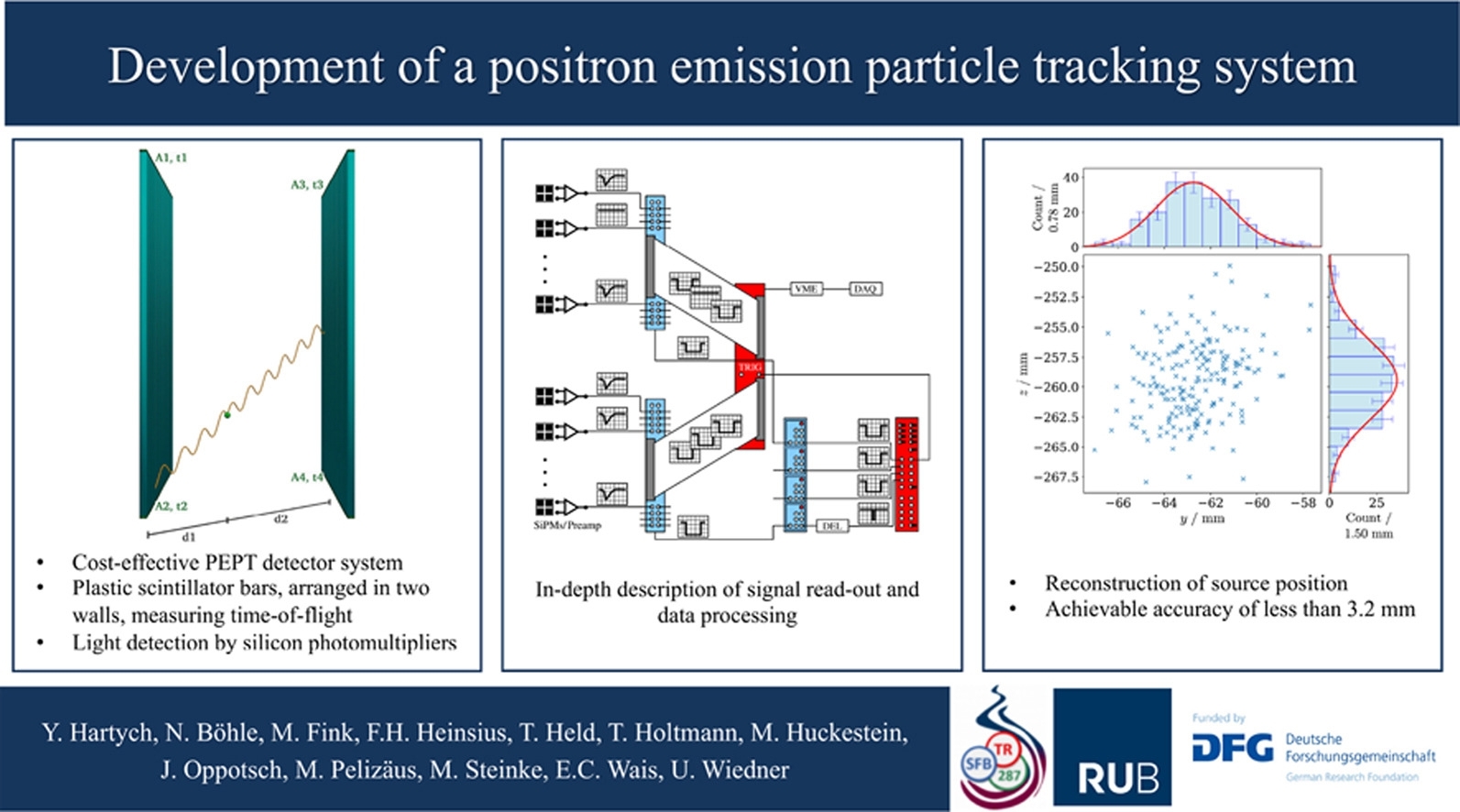
We present the development of a cost-effective detector system for positron emission particle tracking (PEPT) inside dense granular media. The detector is based on the coincident detection of the two back-to-back 511 keV gamma rays produced by electron-positron annihilation. In contrast to most PET systems, which typically employ inorganic crystal scintillators, our design uses elongated organic scintillator bars that are read out at both ends by 2 × 2 arrays of silicon photomultipliers (SiPMs). The detector consists of four modular walls, each comprising 22 scintillator bars, surrounding an observation volume of approximately 0.5 m × 0.5 m × 1 m.
In this work, the position of a stationary radioactive positron source is reconstructed using the first commissioned detector configuration, consisting of two opposing walls with every second scintillator bar instrumented. The complete detector readout chain and the data processing and reconstruction algorithms are presented in detail. By exploiting precise timing information from the scintillation signals, the annihilation position is reconstructed using consecutive time-of-flight (ToF) analyses. The experimental results are compared with previously published Monte Carlo simulations of the same detector configuration.
Although only one quarter of the final detector is currently operational, the reconstructed source position exhibits a root mean square deviation below 3.2 mm. These results demonstrate the feasibility of the proposed detector concept and provide a strong experimental foundation for the completion of the full four-wall PEPT system.
Graphical abstract
Keywords
Positron emission particle tracking (PEPT); Radionuclide imaging; Time-of-flight; Silicon photomultipliers (SiPMs)
文章导读