
期刊文章
过刊浏览
- Volumes 108-119 (2025)
-
Volumes 96-107 (2025)
-
Volume 107
Pages 1-376 (December 2025)
-
Volume 106
Pages 1-336 (November 2025)
-
Volume 105
Pages 1-356 (October 2025)
-
Volume 104
Pages 1-332 (September 2025)
-
Volume 103
Pages 1-314 (August 2025)
-
Volume 102
Pages 1-276 (July 2025)
-
Volume 101
Pages 1-166 (June 2025)
-
Volume 100
Pages 1-256 (May 2025)
-
Volume 99
Pages 1-242 (April 2025)
-
Volume 98
Pages 1-288 (March 2025)
-
Volume 97
Pages 1-256 (February 2025)
-
Volume 96
Pages 1-340 (January 2025)
-
Volume 107
-
Volumes 84-95 (2024)
-
Volume 95
Pages 1-392 (December 2024)
-
Volume 94
Pages 1-400 (November 2024)
-
Volume 93
Pages 1-376 (October 2024)
-
Volume 92
Pages 1-316 (September 2024)
-
Volume 91
Pages 1-378 (August 2024)
-
Volume 90
Pages 1-580 (July 2024)
-
Volume 89
Pages 1-278 (June 2024)
-
Volume 88
Pages 1-350 (May 2024)
-
Volume 87
Pages 1-338 (April 2024)
-
Volume 86
Pages 1-312 (March 2024)
-
Volume 85
Pages 1-334 (February 2024)
-
Volume 84
Pages 1-308 (January 2024)
-
Volume 95
-
Volumes 72-83 (2023)
-
Volume 83
Pages 1-258 (December 2023)
-
Volume 82
Pages 1-204 (November 2023)
-
Volume 81
Pages 1-188 (October 2023)
-
Volume 80
Pages 1-202 (September 2023)
-
Volume 79
Pages 1-172 (August 2023)
-
Volume 78
Pages 1-146 (July 2023)
-
Volume 77
Pages 1-152 (June 2023)
-
Volume 76
Pages 1-176 (May 2023)
-
Volume 75
Pages 1-228 (April 2023)
-
Volume 74
Pages 1-200 (March 2023)
-
Volume 73
Pages 1-138 (February 2023)
-
Volume 72
Pages 1-144 (January 2023)
-
Volume 83
-
Volumes 60-71 (2022)
-
Volume 71
Pages 1-108 (December 2022)
-
Volume 70
Pages 1-106 (November 2022)
-
Volume 69
Pages 1-122 (October 2022)
-
Volume 68
Pages 1-124 (September 2022)
-
Volume 67
Pages 1-102 (August 2022)
-
Volume 66
Pages 1-112 (July 2022)
-
Volume 65
Pages 1-138 (June 2022)
-
Volume 64
Pages 1-186 (May 2022)
-
Volume 63
Pages 1-124 (April 2022)
-
Volume 62
Pages 1-104 (March 2022)
-
Volume 61
Pages 1-120 (February 2022)
-
Volume 60
Pages 1-124 (January 2022)
-
Volume 71
- Volumes 54-59 (2021)
- Volumes 48-53 (2020)
- Volumes 42-47 (2019)
- Volumes 36-41 (2018)
- Volumes 30-35 (2017)
- Volumes 24-29 (2016)
- Volumes 18-23 (2015)
- Volumes 12-17 (2014)
- Volume 11 (2013)
- Volume 10 (2012)
- Volume 9 (2011)
- Volume 8 (2010)
- Volume 7 (2009)
- Volume 6 (2008)
- Volume 5 (2007)
- Volume 4 (2006)
- Volume 3 (2005)
- Volume 2 (2004)
- Volume 1 (2003)
Volume 117
Orbital-hybridization-driven electron transfer triggers the reductive susceptibility of solvated cyclic carbonates
Tong Wu a, Chen-Chen Wang a, Jin-Hao Zhang a, Wen-Ping Ju a, Zhong-Yang Liu a, Xi Xu a, Jin-Hao Meng c, Yu-Zhen Zhao b *, Long Kong a *
a School of Flexible Electronics, Northwestern Polytechnical University, Xi'an, 710129, China
b Shaanxi Key Laboratory of Liquid Crystal Polymer Intelligent Display, Technological Institute of Materials & Energy Science (TIMES), School of Materials and New Energy, Xijing University, Xi'an, 710123, China
c School of Electrical Engineering, Xi'an Jiaotong University, Xi'an, 710049, China
10.1016/j.partic.2026.08.018
Volume 117,
October 2026,
Pages 550-557
Received 8 August 2026, Revised 16 August 2026, Accepted 18 August 2026, Available online 19 August 2026, Version of Record 28 August 2026.
E-mail:
zhaoyuzhen@xijing.edu.cn; iamlkong@nwpu.edu.cn
Highlights
• Analyzing factors governing solvent decomposition via intrinsic physicochemical properties.
• Analyzing factors influencing decomposition based on Li+–solvent interactions.
• Elucidating solvent decomposition factors via Li+–solvent interactions.
• Revealing reductive decomposition mechanisms via molecular orbital analysis.
Abstract
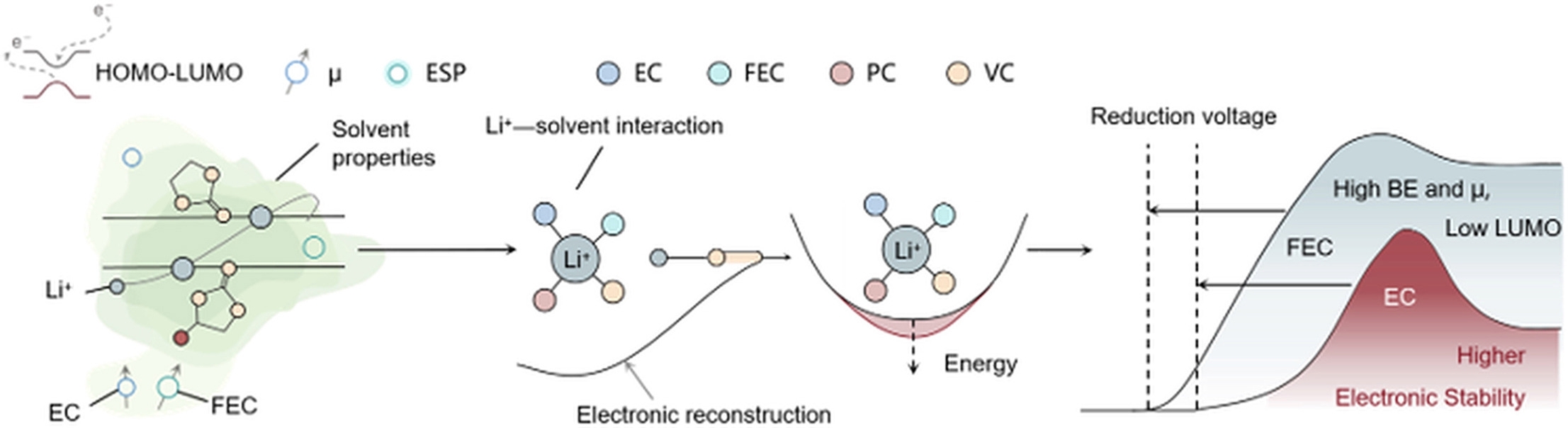
Carbonate-based solvents are widely used in lithium-ion batteries due to their excellent solvation ability, high fluidity after blending, and the capability to form a solid electrolyte interphase (SEI) film through sacrificial reductive decomposition. However, as the core components of the electrolyte, the decomposition mechanism and microscopic influencing factors of cyclic carbonates remain unclear. To address this issue, this study employs multiple methods to comparatively investigate the properties and reduction behaviour of several cyclic carbonates. The results show that cyclic carbonates are more prone to reductive decomposition after forming solvation structures with lithium ions. Furthermore, influenced by molecular structure, the enhancement magnitude of the decomposition ability after solvation exhibits significant differences among different solvents. By analyzing the electronic structures and frontier orbitals, this paper reveals the microscopic mechanism: the leap in reduction ability in the solvated state essentially originates from the orbital hybridization effect between solvent molecules and the central lithium ion. This work clarifies how cyclic carbonates decompose via electron transfer, offering key theoretical insights to guide electrolyte optimization and electrode interface modification.
Graphical abstract
Keywords
Cyclic carbonates; Reductive decomposition; Orbital hybridization; Steric effects; Electronic effects
文章导读