
Volume 118
Revisiting the operating regimes of gas-solid fluidization: Does fast fluidization exist in industry?
Jiaying Wang a b, Jesse Zhu a b *
a Department of Chemical and Biochemical Engineering, The University of Western Ontario, London, Ontario, N6A 3K7, Canada
b Department of Chemical and Biomolecular Engineering, Eastern Institute of Technology, Ningbo, Zhejiang, 315200, China
10.1016/j.partic.2026.08.016
Volume 118,
November 2026,
Pages 16-29
Received 27 February 2026, Revised 24 June 2026, Accepted 9 August 2026, Available online 14 August 2026, Version of Record 1 September 2026.
E-mail:
jzhu@uwo.ca
Highlights
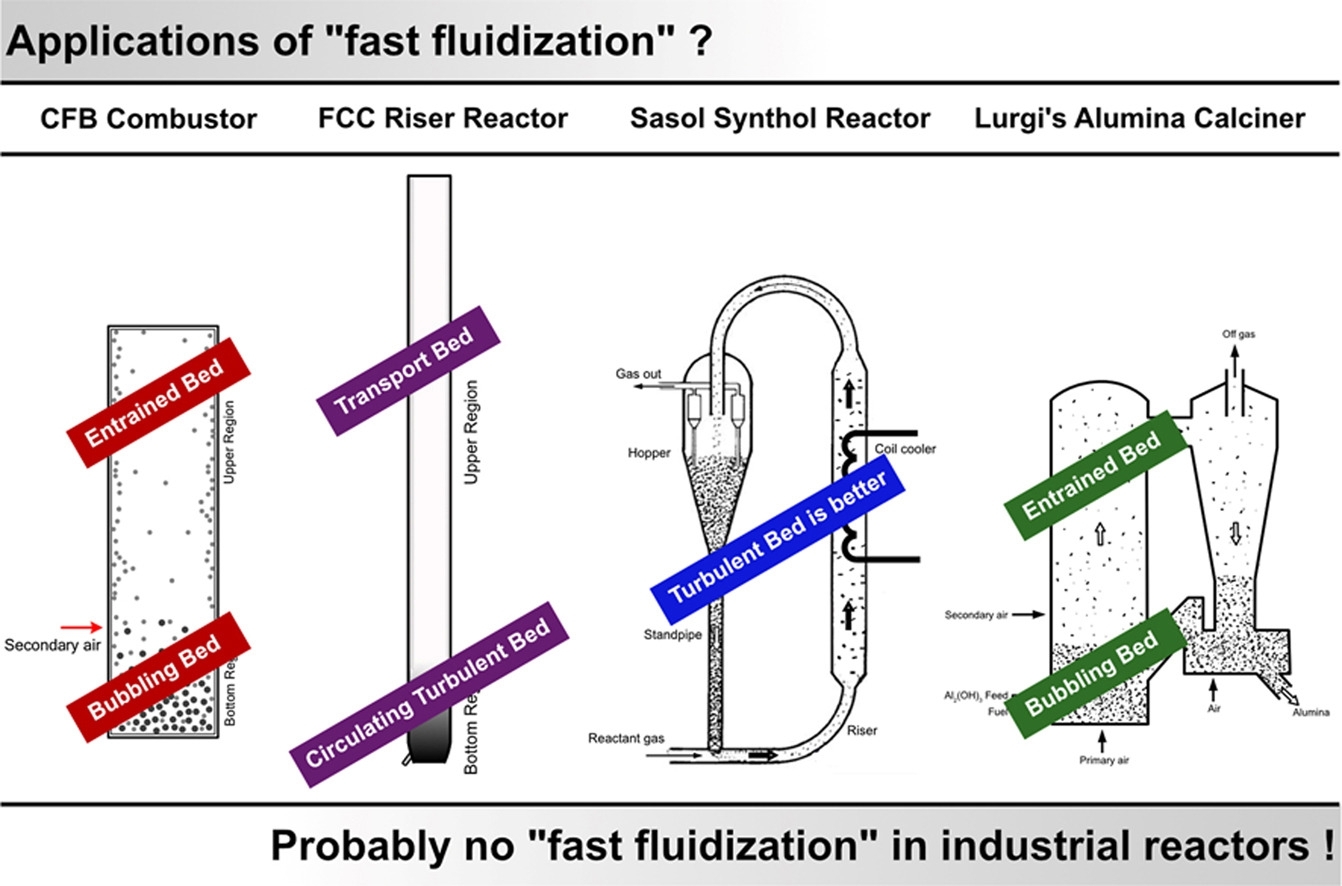
• The bottom region of conventional FCC risers operates as a circulating turbulent fluidized bed.
• The upper region of conventional FCC riser units can be viewed as a pneumatic transport bed.
• The practical applicability of the fast fluidization regime in industry is limited.
Abstract
Gas-solid fluidization relies on selecting appropriate operating regimes as the first and foremost consideration for diverse applications. Among different fluidization modes, the proposal of fast fluidization has long been debated. The two epoch-making applications, circulating fluidized bed combustors (CFBC) and fluid catalytic cracking (FCC) risers, are traditionally regarded as fast fluidized beds. The hydrodynamics in CFBC was described as the superposition of a bubbling bed in the bottom region and an entrained bed in the upper region as we previously reported (Fuel, 2021). This study suggests conventional FCC risers operate as a circulating turbulent fluidized bed in the bottom-section with pneumatic solids transport in the upper-section, through investigation into hydrodynamics and oil conversions in the reactor. Without these two foundational operations, fast fluidization regime appears to lack industrial applicability and may be better regarded as a theoretical extension bridging bubbling and turbulent fluidization.
Graphical abstract
Keywords
Gas-solid fluidization; Regimes; Fast fluidization; Application; FCC riser
文章导读