
Volume 118
Chromate passivation layer for enhancing stability and compatibility of high-lithium alloy powder
Yan Cao, Jianxin Hu *, Maoxing Guo, Ying Ma *, Pan Luo, Lian Duan, Linsong Gao
School of Mechanical Engineering and Mechanics, Xiangtan University, Xiangtan, China
10.1016/j.partic.2026.08.027
Volume 118,
November 2026,
Pages 88-99
Received 3 July 2026, Revised 19 August 2026, Accepted 27 August 2026, Available online 28 August 2026, Version of Record 9 September 2026.
E-mail:
hujianxin@xtu.edu.cn; maying_xtu@126.com
Highlights
• Dense chromate conversion coating (∼1.3 μm) was formed on Al-10Li alloy.
• Al-10Li@CCC robustly preserves a high combustion heat of 31.27 kJ/g.
• Passivation ensures excellent compatibility with propellant components.
• Aging mass decay rate plummeted from 40.08% to 3.37% under high humidity.
Abstract
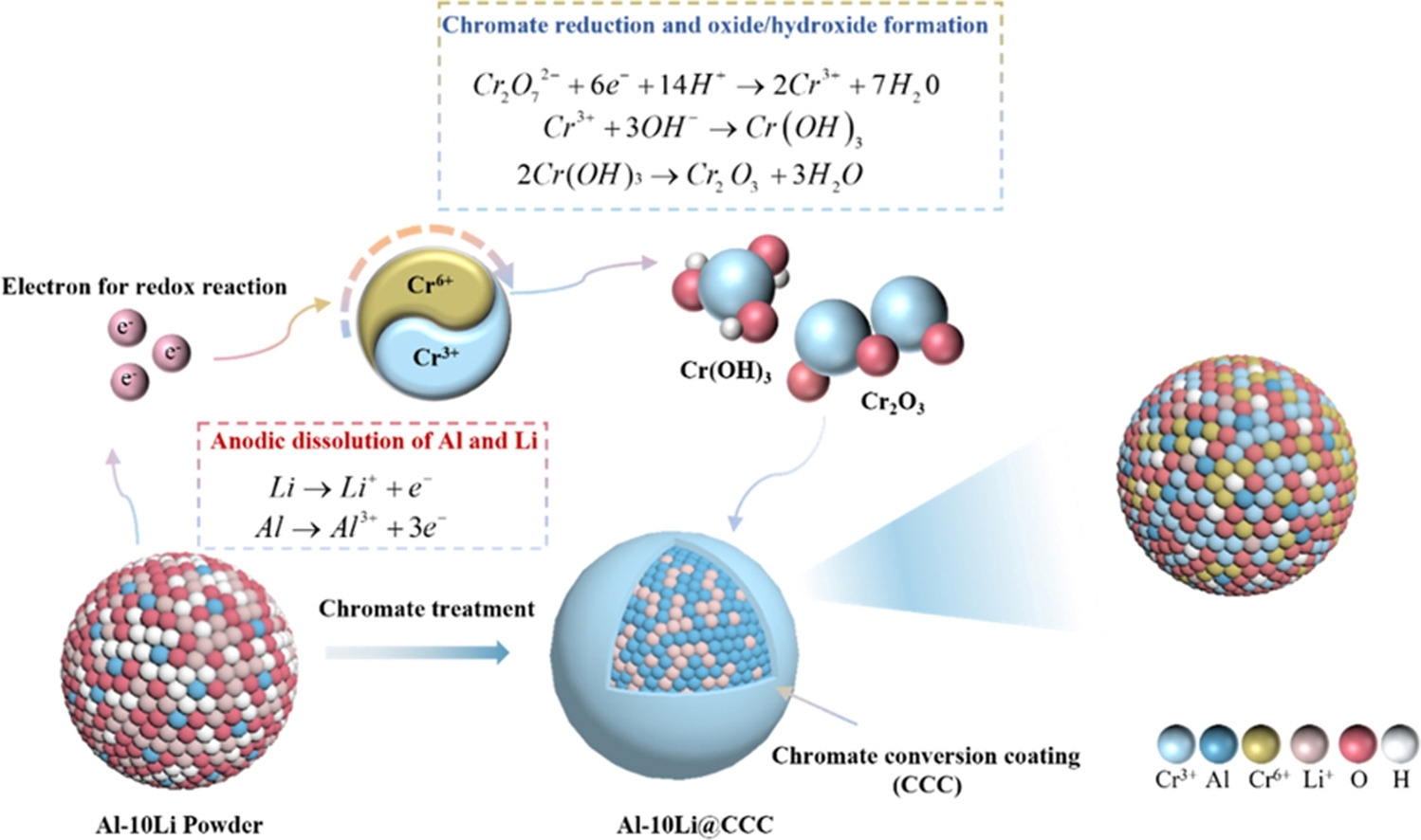
Aluminum-lithium (Al-Li) alloy powders are high-performance energetic fuels, yet the extreme reactivity of lithium severely compromises their environmental stability. In this study, a facile chromate passivation strategy is employed to surface-modify high-lithium-content Al-10Li alloy powders (10 wt% Li), successfully constructing a robust chromate passivation coating (CCC) on the particle surface. Scanning electron microscopy (SEM), X-ray photoelectron spectroscopy (XPS), and focused ion beam transmission electron microscopy (FIB-TEM) confirm that this CCC is dense and multi-layered, with an average thickness of approximately 1.3 μm. Thermal analysis reveals that the passivated powder (Al-10Li@CCC) robustly preserves its high energetic characteristics, delivering a heat of combustion of 31.27 kJ/g. Furthermore, the surface hydrophobicity is significantly enhanced, with the water contact angle increasing from 34.6° to 91.7°. This modification ensures excellent interfacial compatibility with typical propellant components (e.g., ammonium perchlorate and hydroxyl-terminated polybutadiene), maintaining mass variations strictly below 0.2% (75 °C, 48 h). Accelerated aging tests further demonstrate that the Al-10Li@CCC powder possesses superior environmental stability under extreme conditions. This work provides a scalable technical reference for passivating highly reactive metal fuels, effectively preserving their energy-release potential for advanced solid propellants while ensuring environmental reliability.
Graphical abstract
Keywords
Al-10Li alloy powders; Chromate passivation; Solid propellants; Surface coating
文章导读