
Volume 118
Parameter calibration of the discrete element method for micron-scale superabsorbent polymer particles with irregular morphology
Hongen Ge a b, Chunyang Guo a, Hao Liu a, Juntao Li a, Xin Zhang a b *
a College of Mechanical and Electronic Engineering, Shandong University of Science and Technology, Qingdao, 266590, China
b Shandong Key Laboratory of Collaborative Mining Technology for Intelligent Mine Equipment, Qingdao, 266590, China
10.1016/j.partic.2026.08.031
Volume 118,
November 2026,
Pages 128-142
Received 15 June 2026, Revised 6 August 2026, Accepted 29 August 2026, Available online 31 August 2026, Version of Record 12 September 2026.
E-mail:
zhangxin@sdust.edu.cn
Highlights
• DEM calibration for irregular micron-scale SAP particles using JKR model.
• Significant parameters identified via Plackett–Burman and steepest ascent.
• Optimized second-order model established using Box–Behnken design.
• Simulated angle of repose agrees with experiment within 1.63% error.
Abstract
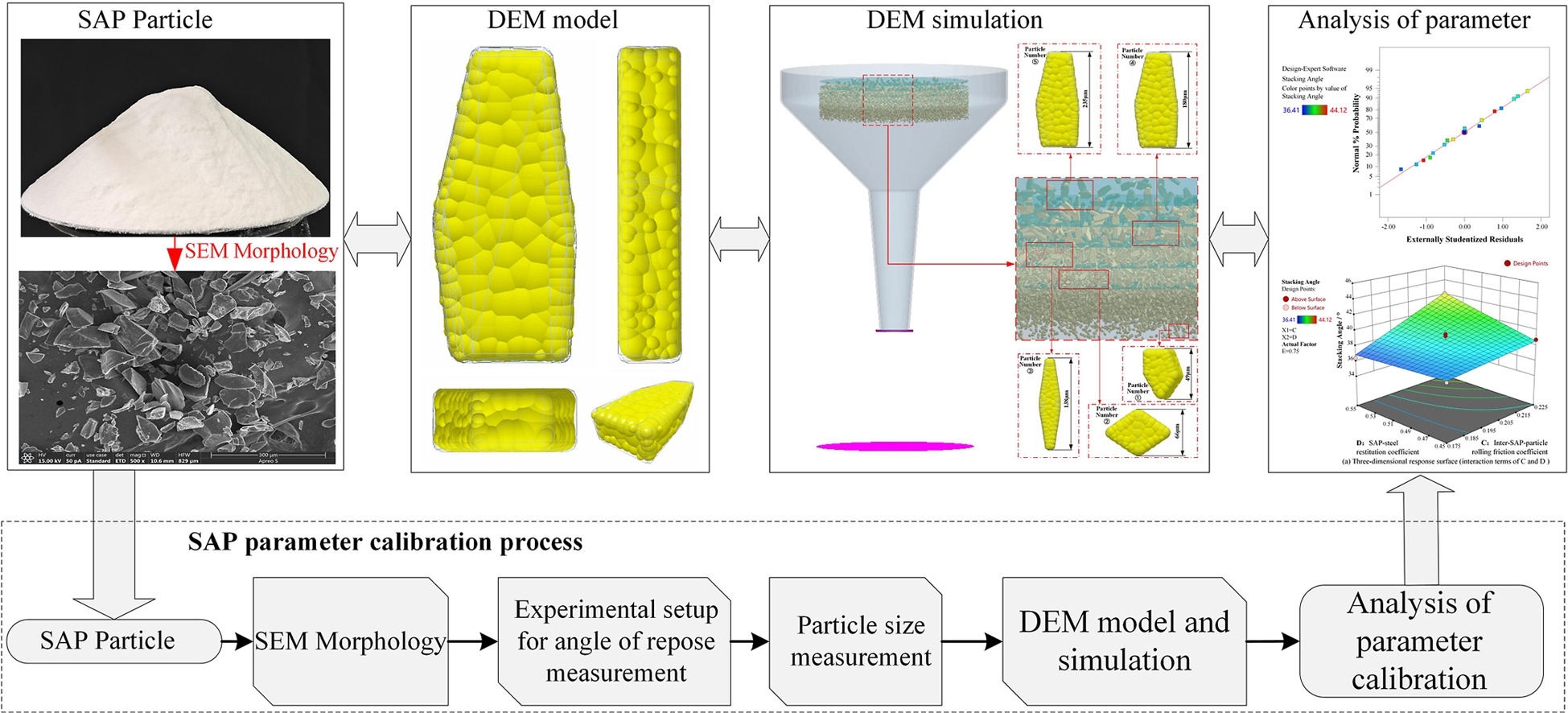
To address the challenge of accurately calibrating discrete element method (DEM) parameters for superabsorbent polymer (SAP) particles with irregular morphology and micron-scale size, a combined experimental–numerical calibration strategy was developed to enhance simulation reliability. The angle of repose was measured as 39.17° using digital image processing and adopted as the response variable. A DEM model was established in EDEM based on the actual particle size distribution and morphology, and the JKR contact model was employed for calibration. Three significant parameters governing particle flow behavior were identified via Plackett–Burman design: particle–particle rolling friction coefficient, particle–stainless steel restitution coefficient, and particle–stainless steel static friction coefficient. The optimal region was determined using a two-stage steepest ascent method. A refined second-order regression model was subsequently constructed using Box–Behnken design, yielding optimal values of 0.188, 0.469, and 0.735. Validation results show that the mean simulated angle of repose is 39.81° with the relative error is 1.63%. These results demonstrate that the calibrated parameters can reliably reproduce the macroscopic behavior of SAP particles. This study provides a reproducible framework for DEM calibration of irregular micron-scale particles.
Graphical abstract
Keywords
Superabsorbent polymer particles; Parameter calibration; EDEM; Angle of repose; Second-order regression model
文章导读