
Volume 118
Anion sequestration tailors electrolyte aggregates for fast-charging lithium batteries
Xin Li, Yan Li *, Yan Wang, Chengzong Li, Tao Li *
School of Resource Environment and Safety Engineering, University of South China, Hengyang, 421001, China
10.1016/j.partic.2026.09.003
Volume 118,
November 2026,
Pages 175-184
Received 21 August 2026, Revised 2 September 2026, Accepted 4 September 2026, Available online 5 September 2026, Version of Record 16 September 2026.
E-mail:
li-yan@usc.edu.cn; li-tao@usc.edu.cn
Highlights
• Anion sequestration tailors weakly solvating electrolyte aggregates.
• TPFPB lowers FSI− activity and suppresses overextended AGG networks.
• CIP-rich motifs reduce desolvation barriers and enhance Li+ transference.
• Anion-derived interphase chemistry is preserved after aggregate tailoring.
• Li||NCM523 cells fast-charge to 70% SOC within 18 min for 123 cycles.
Abstract
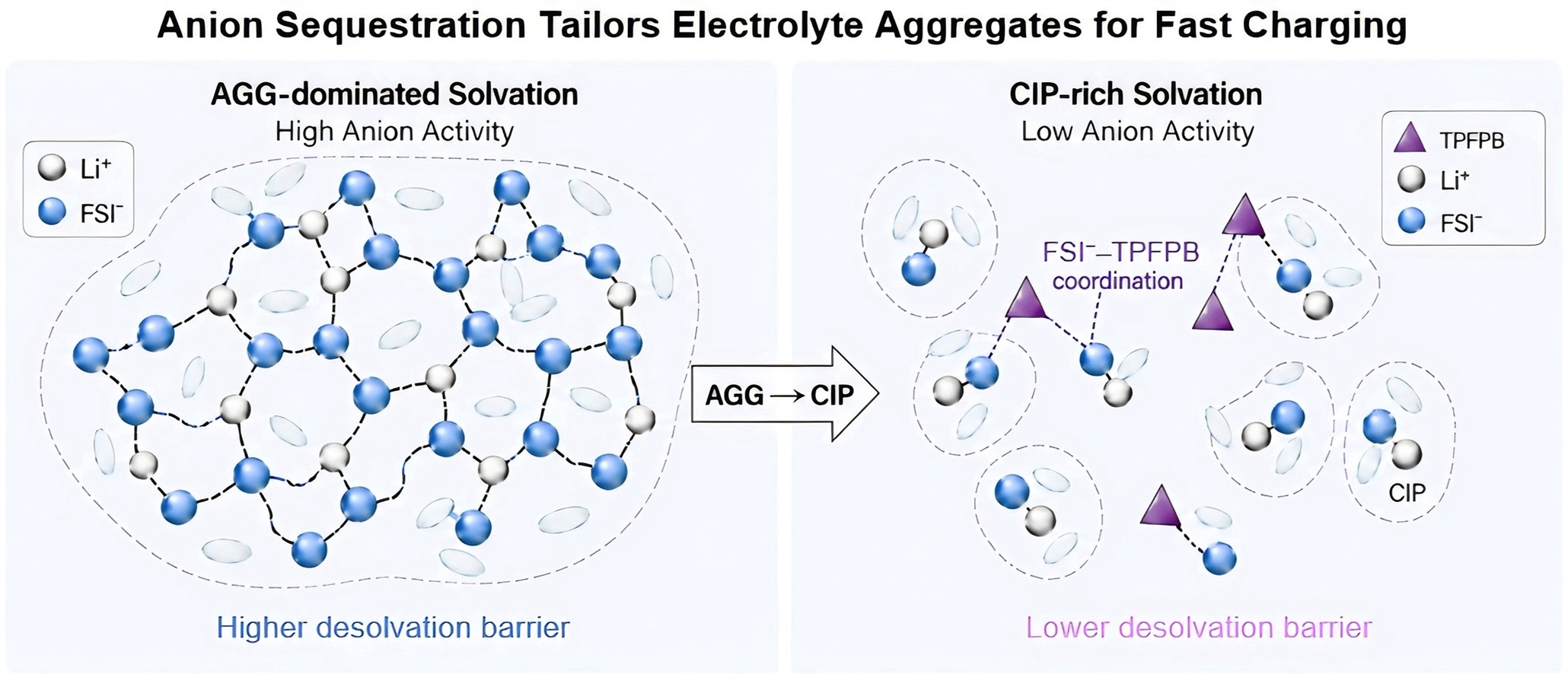
Electrolyte aggregates in weakly solvating electrolytes (WSEs) favor the formation of anion-derived inorganic-rich interphases, but their pronounced ion association can impede Li+ transport and exacerbate polarization under fast-charging conditions. Here we report an anion-sequestration strategy to tailor electrolyte aggregates in a tetrahydropyran (THP)-based WSE. Tris (pentafluorophenyl)borane (TPFPB) strongly binds FSI− and lowers its effective activity, thereby weakening anion-bridged aggregation and shifting the association equilibrium from extended aggregates toward smaller contact ion pairs (CIPs). As a result, the Li+ desolvation barrier decreases from 59.86 to 55.12 kJ mol−1, the CIP fraction increases from 44.9% to 52.6%, and the Li+ transference number increases from 0.31 to 0.63, collectively accelerating interfacial Li+ transport. As a proof of concept, the aggregate-tuned WSE enables Li||NCM523 full cells with a high-areal-capacity cathode (3 mAh cm−2) to sustain 3 C fast charging (9 mA cm−2), repeatedly reaching 70% state of charge within 18 min over 123 cycles while retaining 97.2% of capacity. In contrast, the pristine WSE becomes polarization-limited, accepting only 48% state of charge with 74.6% retention. These results establish anion sequestration as an effective lever to reconcile interphase-forming solvation chemistry with desolvation/transport kinetics for fast-charging lithium batteries.
Graphical abstract
Keywords
Anion sequestration; Weakly solvating electrolytes; Aggregate tailoring; Li+ transport/desolvation; Fast-charging lithium batteries
文章导读