
Volume 118
On the sediment height criterion for confined non-Newtonian suspensions
Allan Barbosa Geoffroy Motta a *, Elessandre Alves de Souza b, Luiz Augusto da Cruz Meleiro a, Luís Américo Calçada a, Cláudia Miriam Scheid a
a Department of Chemical Engineering, Federal Rural University of Rio de Janeiro, UJ Street, Seropédica, Rio de Janeiro, 23890-000, Brazil
b Research and Development Center Leopoldo Américo Miguez de Mello, Petrobras, Av. Horácio Macedo 950, Cidade Universitária, Rio de Janeiro, Rio de Janeiro, 21941-970, Brazil
10.1016/j.partic.2026.08.037
Volume 118,
November 2026,
Pages 208-216
Received 3 August 2026, Revised 22 August 2026, Accepted 30 August 2026, Available online 8 September 2026, Version of Record 16 September 2026.
E-mail:
allanbgmotta@ufrrj.br
Highlights
• We proposed a sediment height criterion applicable to solids concentration profiles.
• The criterion was able to track the upper and lower sedimentation interfaces.
• Axial concentration profiles are usual outputs of continuum models.
• The proposed methodology fit several tested cases.
Abstract
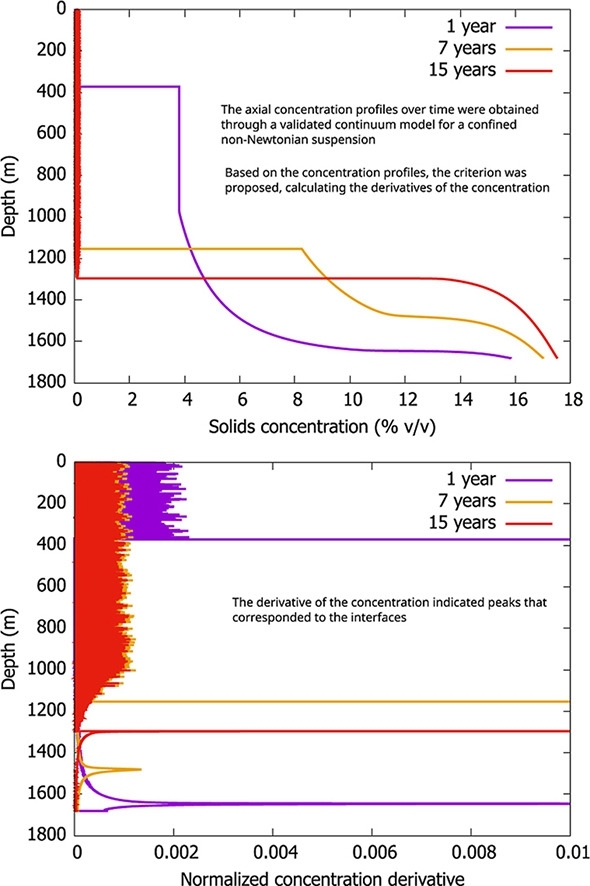
The sedimentation process is mainly characterized by two interfaces: the upper interface, which defines the separation between the clarified zone and a concentrated zone; the lower interface, which defines the separation between the compacted structure and the suspension. Continuum models for the sedimentation process usually have the local solids concentration as output. The upper interface is easy to track in many experiments, as just before the interface, the solids concentration is near zero. However, at the compression zone, there may be no jump of concentration to clearly define the lower interface. The difficulty appears also in computational analyses. In this work, we proposed a sediment height criterion to track the lower interface based on the numerical concentration profiles and the derivatives of the concentration with respect to depth. We employed a previously developed and validated continuum model for sedimentation of non-Newtonian suspensions and simulated cases of drilling fluids confined in the annulus of an oil well to evaluate the performance and applicability of the criterion. The model was discretized using the finite volume method and implemented, alongside the proposed criterion. A base case was considered, and derived cases were studied, including cases with linear and geothermal temperature profiles. A case with two confined suspensions was analyzed. The evolution of upper and lower interfaces over time, using the proposed criterion, has shown the expected behavior based on the classical sedimentation theory. The temperature profiles played a key role in the evolution of the interfaces, particularly the upper one, where there was no linear regime. This effect was attributed to changes in the free settling zone caused by local variation of temperature, which impacted the rheology and affected the equilibrium of the zone.
Graphical abstract
Keywords
Sediment height; Sedimentation interfaces; Continuum modeling
文章导读