
Volume 118
Identification and quantification of orientationally ordered clusters in packings of frictionless elliptical particles
Haoran Jiang a b *, Ruidong Li c, Xiaoyu Jiang b, Quanshui Huang d *
a Civil Engineering Design Division, Kajima Corporation, Tokyo, 107-8477, Japan
b Department of Engineering Mechanics and Energy, University of Tsukuba, Ibaraki, 305-8573, Japan
c Department of Civil and Environmental Engineering, The Hong Kong Polytechnic University, Hung Hom, Kowloon, Hong Kong, China
d College of Hydraulic Science and Engineering, Yangzhou University, Yangzhou, 225009, China
10.1016/j.partic.2026.09.001
Volume 118,
November 2026,
Pages 217-229
Received 19 July 2026, Revised 23 August 2026, Accepted 1 September 2026, Available online 5 September 2026, Version of Record 17 September 2026.
E-mail:
jiangh@kajima.com; quanshui@yzu.edu.cn
Highlights
• Compression induces local orientational order in ellipse packings without global order.
• Contact forces weaken with misalignment, linking force transmission to orientational order.
• A force-based angular threshold robustly identifies orientationally ordered clusters.
• Clusters exhibit a universal, model-predicted size distribution and fractal-like shape scaling.
Abstract
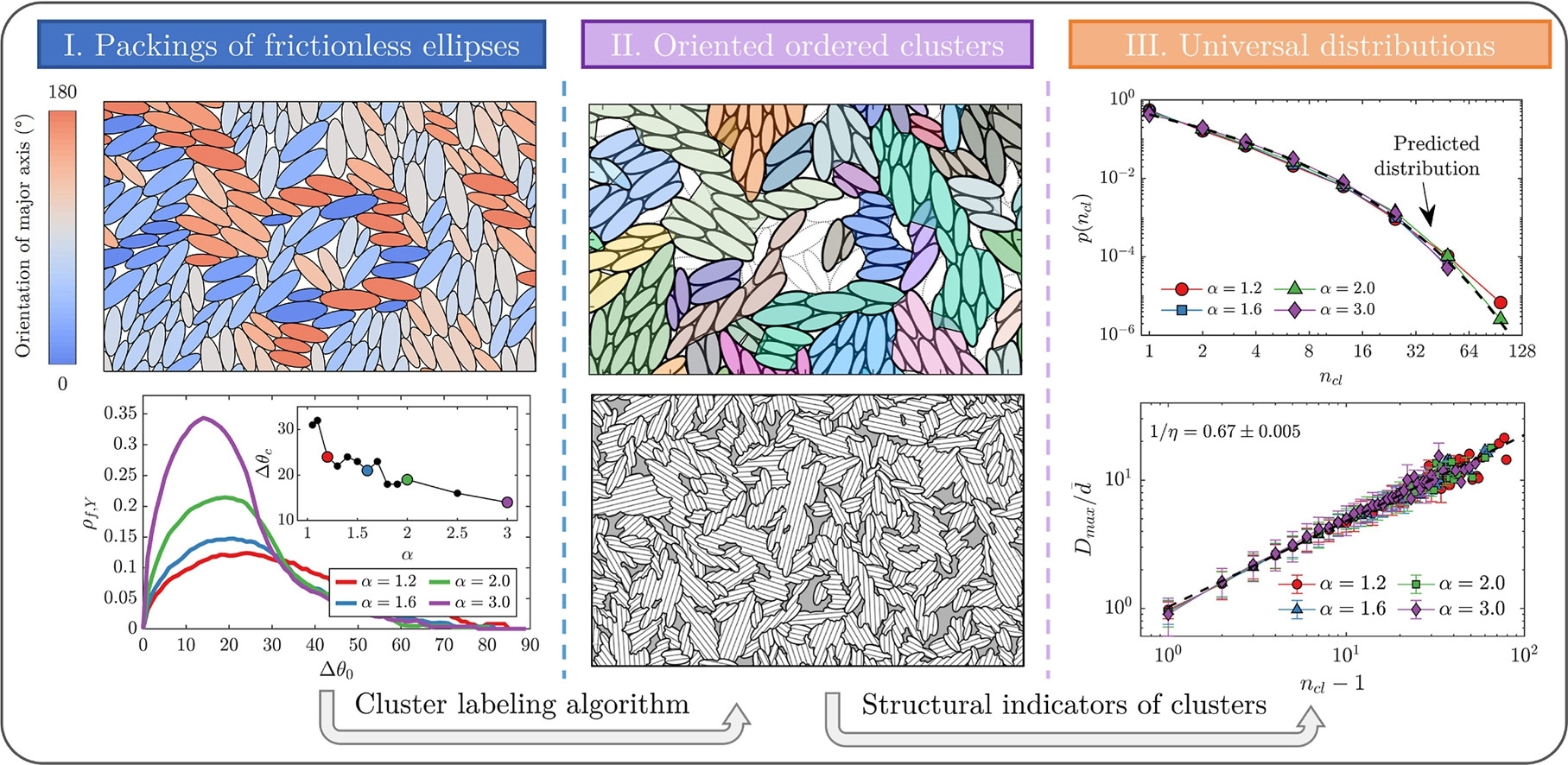
Understanding the ordered alignment of elongated particles in dense granular systems remains a long-standing challenge in soft matter physics and is central to many natural phenomena and technological applications. In this study, the discrete element method (DEM) is used to investigate the emergence of local orientational ordering in isotropically compressed packings of frictionless ellipses with varying aspect ratios. A cluster labeling algorithm is developed to identify orientationally ordered clusters based on contacting particle pairs, with the threshold angle determined by maximizing the correlation between cluster membership and force transmission. Despite the absence of global orientational order, the packings exhibit pronounced local alignment that can be quantitatively characterized by the identified clusters. The cluster size distributions collapse onto a universal master curve largely independent of particle aspect ratio, and a theoretical model is proposed that successfully reproduces the observed distributions. In addition, the cluster shapes exhibit fractal-like scaling with a nearly constant scaling exponent across all systems examined. These robust scaling patterns are signatures of mechanics-driven self-organization in granular systems composed of elongated particles and may serve as a foundation for future mesoscopic and continuum modeling of such materials.
Graphical abstract
Keywords
Orientationally ordered clusters; DEM simulation; Particle shape; Cluster labeling algorithm; Mesoscopic structure
文章导读