
Volume 118
Recycling of sinter return fines via cold-bonding and hot-hardening briquetting for low-carbon ironmaking
Litan Yin a, Fan Yang a, Wang Zeng a, Jiguo Tu a, Heng Zhou b *, Shengli Wu b, Mingyin Kou a *
a State Key Laboratory of Advanced Metallurgy, University of Science and Technology Beijing, Beijing, 100083, China
b School of Metallurgical and Ecological Engineering, University of Science and Technology Beijing, Beijing, 100083, China
10.1016/j.partic.2026.08.019
Volume 118,
November 2026,
Pages 230-245
Received 1 June 2026, Revised 25 July 2026, Accepted 19 August 2026, Available online 3 September 2026, Version of Record 17 September 2026.
E-mail:
zhouheng@ustb.edu.cn; koumingyin@ustb.edu.cn
Highlights
• The high-performance binder for blast furnace smelting is developed.
• The CBHHB achieve >2500 N strength and 96.6% RDI+3.15, surpassing sinter.
• The applicability of CBHHB products in blast furnace smelting is confirmed.
• The technology adapts to various iron-bearing wastes, enhancing circularity.
Abstract
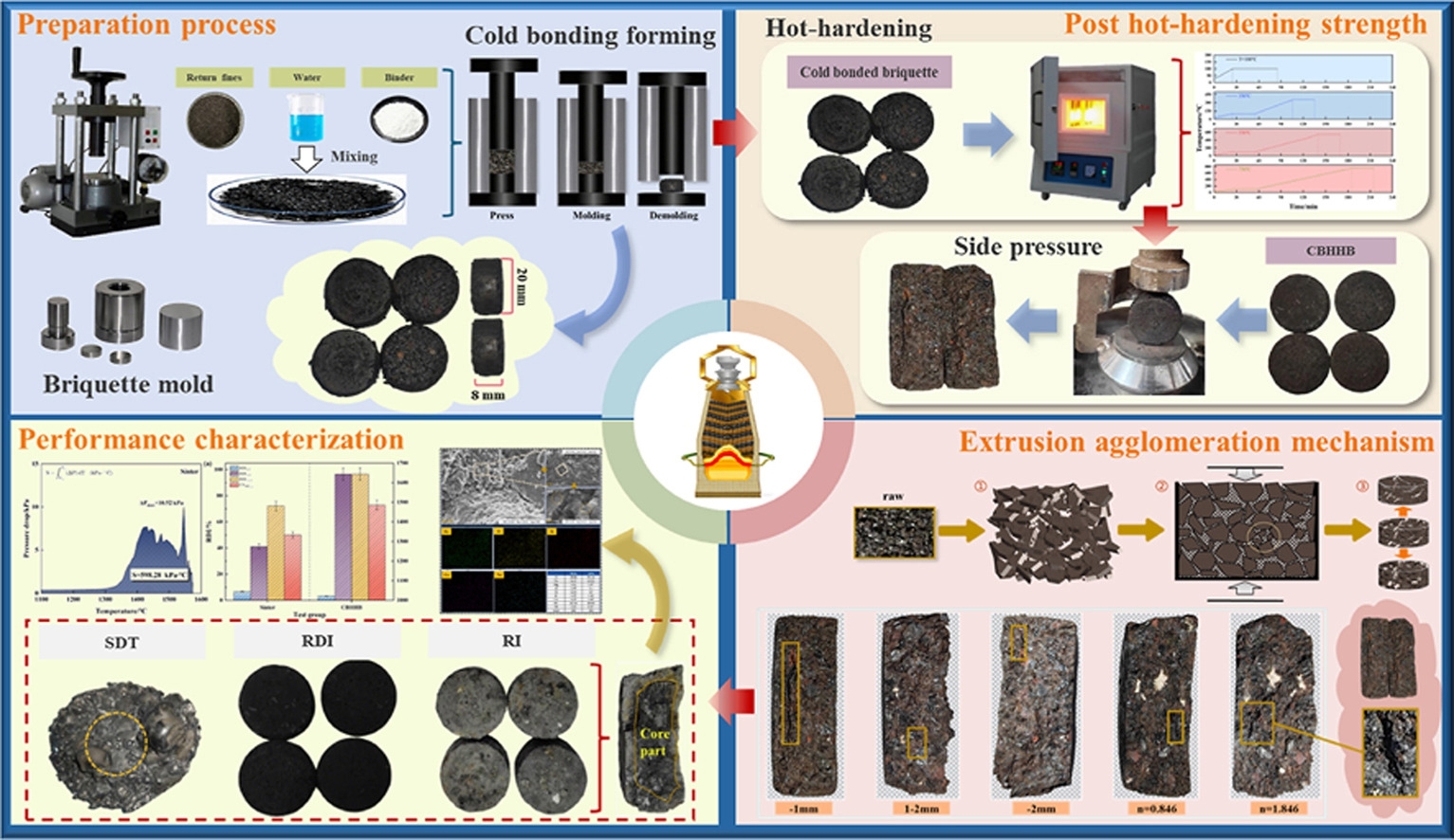
Sinter return fines are iron-rich by-products of iron ore sintering, but conventional re-sintering is energy-intensive and often leads to repeated circulation. This study developed a cold-bonding and hot-hardening briquetting (CBHHB) process to convert these fines directly into blast-furnace burden. Screening of 34 binders, followed by binary and ternary optimization, binder A2B3C1 was identified as the optimal composite binder. Combined with Dinger–Funk particle-packing design and hot hardening at 550 °C, this formulation produced a dense interlocking structure with continuous interfacial bonding. The optimized CBHHB achieved a compressive strength above 2500 N, a reducibility index of 77.05%, an RDI+6.3 of 96.6%, and a post-reduction strength above 900 N. However, CBHHB showed poor melting–dripping permeability. At 30% addition, the S value reached 42.41 kPa °C, 2.23 times of that of the reference burden. FactSage calculations indicated that Phase 12, comprising melilite, monoxide, slag liquid, and a'(Ca,Sr,Ba)2SiO4, broadened with increasing CBHHB content, consistent with the rise in gas-flow resistance. A 20% blending ratio provided the best balance between reduction performance and permeability. This study establishes an integrated framework linking binder formulation, packing structure, metallurgical performance, and phase evolution.
Graphical abstract
Keywords
Sinter return fines; Cold-bonded briquette; Binder; Softening-melting behavior; Blast furnace burden
文章导读