
Volume 118
Novel boron complexes-based photosensitizers characterized by aggregation-induced emission for photodynamic therapy
Herui Yan a, Kejie Xin a, Jiajia Hu a, Shaoshuai Wang a, Ran Zhang a, Heng Liu b *, Xiaoyun Jiao a c, Xu Wang a *, Jian Zhang a c *
a College of Chemistry, Chemical Engineering and Materials Science, Collaborative Innovation Center of Functionalized Probes for Chemical Imaging in Universities of Shandong, Key Laboratory of Molecular and Nano Probes, Ministry of Education, Shandong Provincial Key Laboratory of Clean Production of Fine Chemicals, Shandong Normal University, Jinan, 250014, China
b NHC Key Laboratory of Tropical Disease Control, School of Life Sciences and Medical Technology, Hainan Medical University, Haikou, 571199, China
c State Key Laboratory of Molecular Engineering of Polymers (Fudan University), Shanghai, 200438, China
10.1016/j.partic.2026.09.004
Volume 118,
November 2026,
Pages 305-311
Received 13 August 2026, Revised 3 September 2026, Accepted 8 September 2026, Available online 10 September 2026, Version of Record 18 September 2026.
E-mail:
liuheng11b@muhn.edu.cn; wangxu@sdnu.edu.cn; zhangjian12b@mails.ucas.ac.cn
Highlights
• Novel β-hydroxyimine boron complexes for photodynamic therapy.
• Metal-free photosensitizers characterized with aggregation-induced emission.
• Average tumor inhibition rate of 86.6%.
Abstract
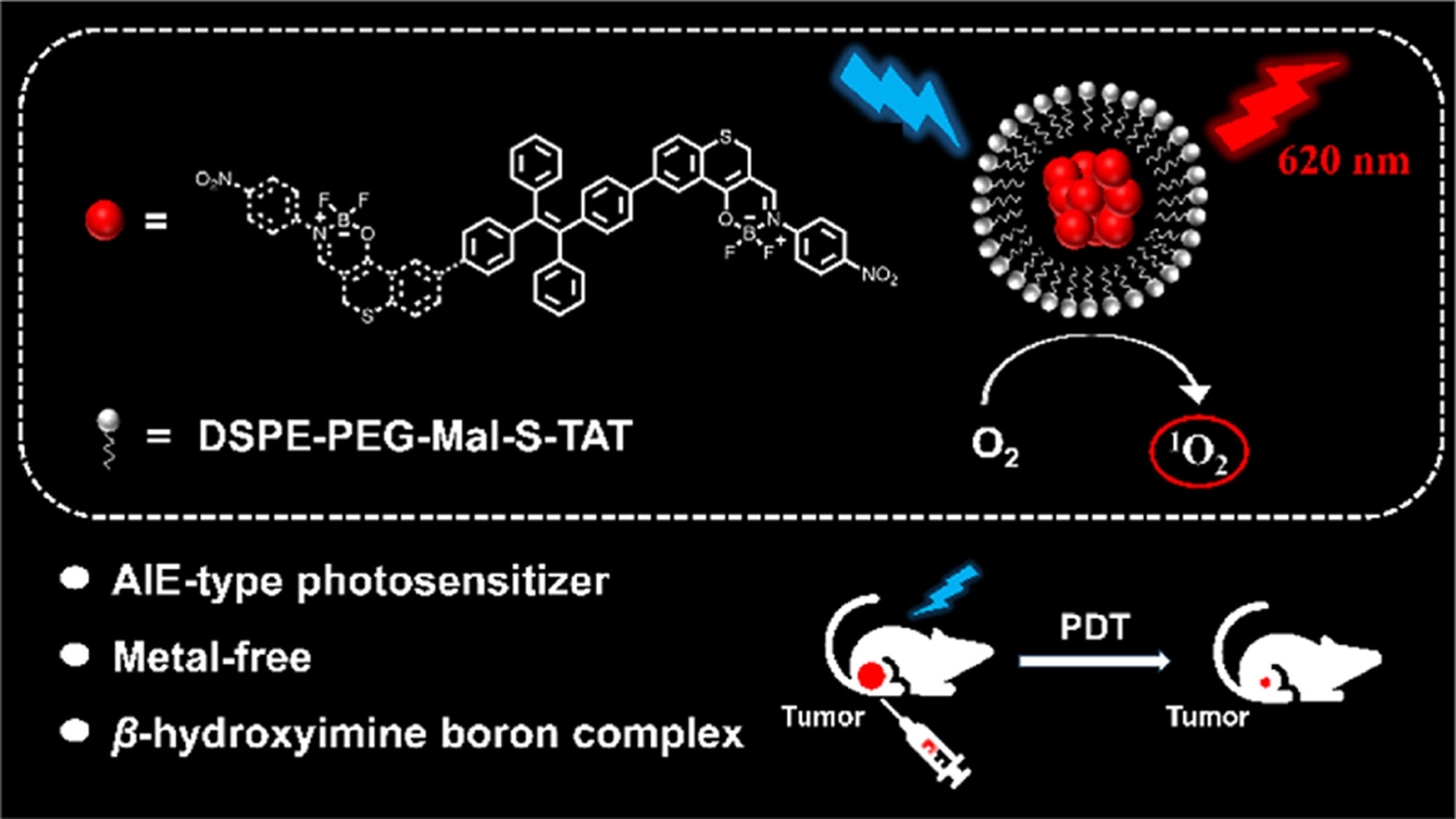
The development of photodynamic therapy (PDT) has significantly advanced cancer treatment. While metal complex-based photosensitizers exhibit high photosensitivity, their metal centers may be susceptible to nucleophilic attacks, potentially leading to reduced sensitizing performance. In contrast, metal-free photosensitizers can face limitations in biological environments, often associated with aggregation-induced deactivation of excited states. To address these challenges, we synthesized two novel β-hydroxyimine boron complex-based photosensitizers, TPE-SF and TPE-2SF, which exhibit aggregation-induced emission (AIE) characteristics and promising antitumor performance in cellular and in vivo models. Theoretical calculations reveal that the intramolecular donor-acceptor (D-A) structure contributes to a reduced singlet-triplet energy gap (ΔEST) and enhanced the spin-orbit coupling (SOC) matrix element, thereby facilitating intersystem crossing (ISC) and supporting their photosensitizing properties. Overall, this work provides insights into the design of metal-free and heavy-atom-free photosensitizers and highlights the potential of β-hydroxyimine boron complexes for photodynamic therapy.
Graphical abstract
Keywords
Photodynamic therapy; Aggregation-induced emission; β-Hydroxyimine boron complex; Metal free
文章导读