
Volume 118
Examination of the synergistic incineration of sludge and fermentation residue along with in-situ alkaline particle release measurement
Tong Sun a b, Ye Yuan a, Xianggui Xu a, Qiao Huang a b, Yun Huang a b *
a State Key Laboratory of Mesoscience and Process Engineering, Institute of Process Engineering, Chinese Academy of Sciences, Beijing, 100190, China
b School of Chemical Engineering, University of Chinese Academy of Sciences, Beijing, 100049, China
10.1016/j.partic.2026.08.020
Volume 118,
November 2026,
Pages 312-324
Received 14 May 2026, Revised 21 August 2026, Accepted 22 August 2026, Available online 27 August 2026, Version of Record 21 September 2026.
E-mail:
yunhuang@ipe.ac.cn
Highlights
• Co-combustion of sludge and residues improves calorific value and combustion behavior.
• PS-LIBS and PLIF revealed real-time particle phase transitions during combustion.
• Particles undergo fragmentation, gasification, melting, and agglomeration.
• Alkali and alkaline earth metals transform into composite salts in the flame field.
• Co-combustion effectively reduces NOx emissions during sludge incineration.
Abstract
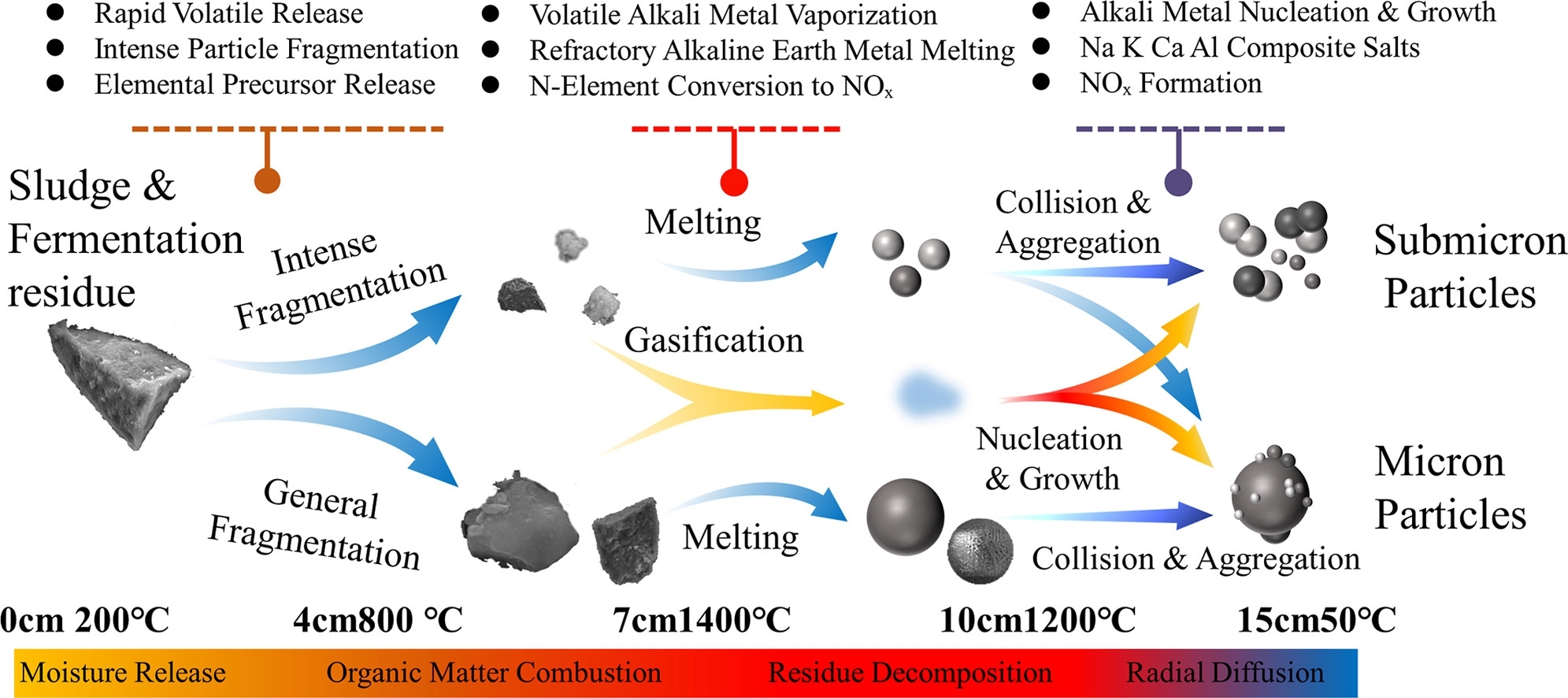
Sewage sludge poses a major challenge for resource utilization and thermal disposal because of its high moisture content, low calorific value, and the slagging and corrosion risks associated with alkali and alkaline earth metals (AAEMs). Synergistic incineration with organic-rich fermentation residue offers a potential route for improving sludge thermal treatment; however, the particle-scale evolution and in-flame transformation behavior of AAEMs during this process remain insufficiently understood. In this study, the synergistic incineration of sludge and fermentation residue was investigated using phase-selective laser-induced breakdown spectroscopy (PS-LIBS) and OH planar laser-induced fluorescence (OH-PLIF), combined with offline X-ray diffraction and fluorescence measurements. PS-LIBS was used to track the relative spatial evolution of particle-phase Na, K, Ca, and Al, while OH-PLIF provided information on flame structure and reaction-zone distribution. The results suggest a possible particle-evolution pathway involving volatile release, fragmentation, alkali vaporization, downstream re-capture, and agglomeration, ultimately leading to the formation of composite inorganic phases. The roles of AAEMs, S, and Cl were further discussed to interpret alkali redistribution and particle-phase signal evolution. Finally, the NOx emissions during the co-combustion of sludge and fermentation residues are examined which showed a certain degree of reduction. These findings provide particle-scale insight into AAEM transformation during sludge–fermentation residue synergistic incineration and offer a useful reference for clean thermal treatment of heterogeneous organic wastes.
Graphical abstract
Keywords
Waste incineration; In-situ diagnostics; Sludge; Fermentation residue; Phase transformation
文章导读