
Volume 118
Influence mechanism of installation angle on condensation characteristics of soiled surfaces of solar photovoltaic panels for condensation-driven self-cleaning
Xueqing Liu a b *, Lu Niu a b, Yanzhao Yu a b, Zhengming Yi a b, Sijia Liang a b, Luyi Lu c, Jianlan Li c
a State Key Laboratory of Advanced Refractories, Wuhan University of Science and Technology, Wuhan, 430081, China
b Key Laboratory for Ferrous Metallurgy and Resources Utilization of Ministry of Education, Wuhan University of Science and Technology, Wuhan, 430081, China
c School of Energy and Power Engineering, Huazhong University of Science and Technology, Wuhan, 430074, China
10.1016/j.partic.2026.09.005
Volume 118,
November 2026,
Pages 350-363
Received 1 June 2026, Revised 16 August 2026, Accepted 10 September 2026, Available online 11 September 2026, Version of Record 21 September 2026.
E-mail:
lxq_wust@wust.edu.cn
Highlights
• Condensation characteristics are compared between clean and soiled PV panels.
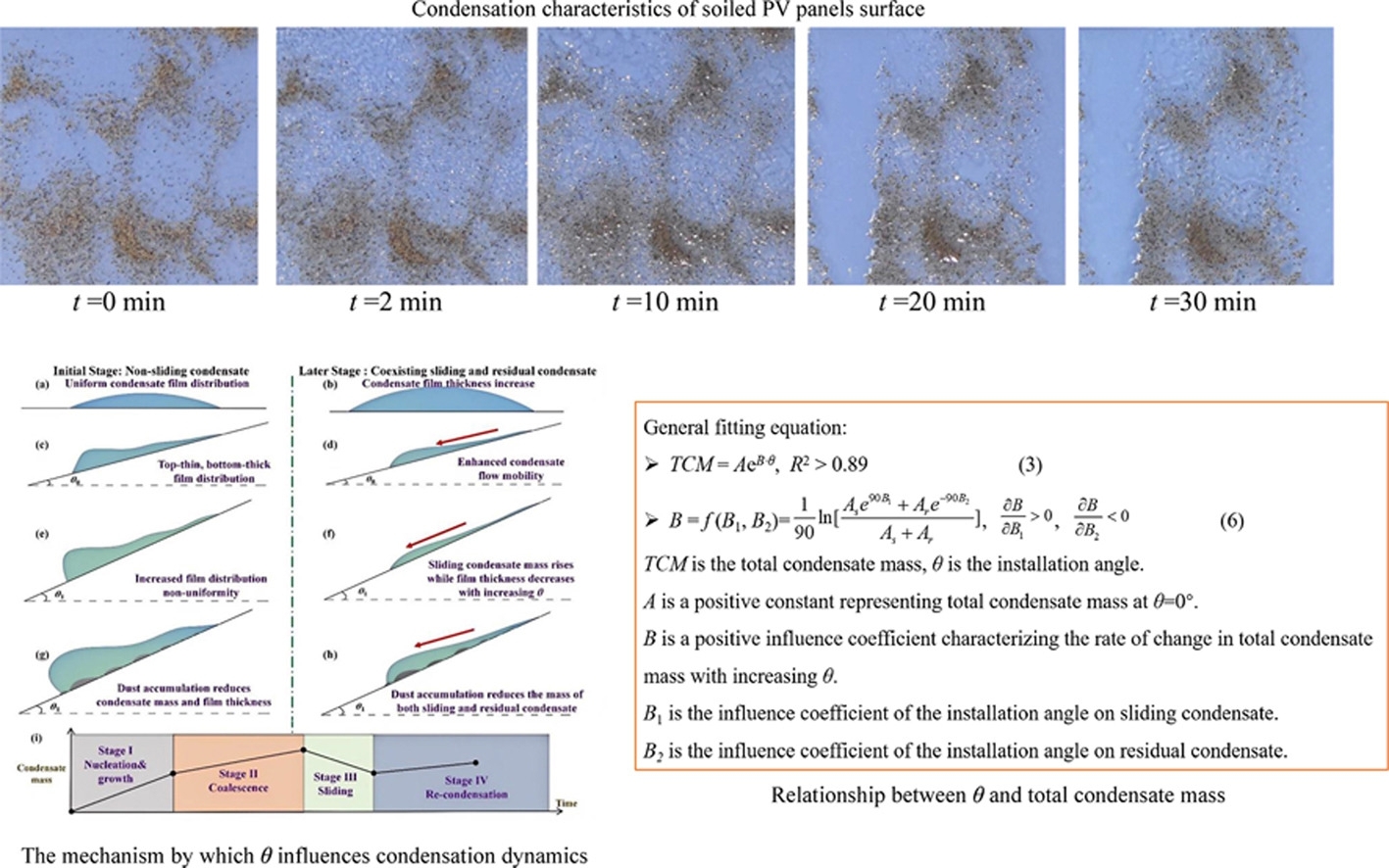
• The mechanism by which θ influences condensation dynamics is revealed.
• A correlation between θ and surface condensation behavior is established.
• The relationship between θ and surface condensate follows TCM = Ae(B·θ).
• Sliding and residual condensates are decoupled to quantify θ′s dual role.
Abstract
Photovoltaic (PV) power generation is pivotal to global carbon neutrality, yet dust accumulation severely impairs its efficiency and lifespan. Condensation-driven self-cleaning, a cost-effective and eco-friendly solution, is highly dependent on PV panel installation angles (θ). This study experimentally investigates condensation characteristics on clean/soiled PV panels and clarifies the influence mechanism of θ on condensation dynamics, establishing a quantitative correlation between θ and surface condensation behavior for self-cleaning optimization. Filmwise condensation enables gravity-driven cleaning, but residual films/dust compromise performance: clean panels exhibit higher condensate sliding (10.2 mg, 7 cycles) than soiled ones (7.4 mg, 6 cycles) in 4-h tests. Inclination modulates condensation via liquid film thickness and mobility; dust accumulation elevates roughness/thermal resistance, suppressing subcooling and condensate generation. A novel analytical framework decouples sliding (enhancing cleaning) and residual (impeding performance) condensate effects. Increasing θ from 15° to 90° boosts sliding condensate (2.95-fold), cleaning frequency (3.75-fold), and transmittance improvement (52.0%), while reducing residual condensate (80.0%) (200 mg dust). The exponential model TCM = Ae(B·θ) (R2 > 0.89) and Eqs. (3) and (6) characterize θ′s counteracting effects (B1: positive sliding contribution; B2: negative residual adhesion), providing a quantitative basis for optimizing PV self-cleaning and offering critical theoretical guidance.
Graphical abstract
Keywords
文章导读