
Volume 118
Numerical investigation on wide-load operating characteristics and dynamic response of a MW-scale oxy-fuel circulating fluidized bed
Mingzheng Li a, Daoyin Liu a *, Shaobo Yang b, Wei Li b, Xiaoping Chen a
a Key Laboratory of Energy Thermal Conversion and Control of Ministry of Education, Southeast University, Nanjing, 210096, China
b Institute of Engineering Thermophysics, Chinese Academy of Sciences, Beijing, 100190, China
10.1016/j.partic.2026.09.008
Volume 118,
November 2026,
Pages 377-390
Received 30 June 2026, Revised 4 September 2026, Accepted 15 September 2026, Available online 17 September 2026, Version of Record 23 September 2026.
E-mail:
dyliu@seu.edu.cn
Highlights
• Oxy-fuel CFB operation characteristics under 30%–120% wide load range.
• MP-PIC model for mechanism analysis under variable load.
• Heat and mass balance model for system dynamic response under variable load.
• At 30% load, dilute zone temperature drops by 72 K compared to 100% load.
• At a load decrease rate of 3% Pe/min, the CO2 disturbance in flue gas reaches 3.14%.
Abstract
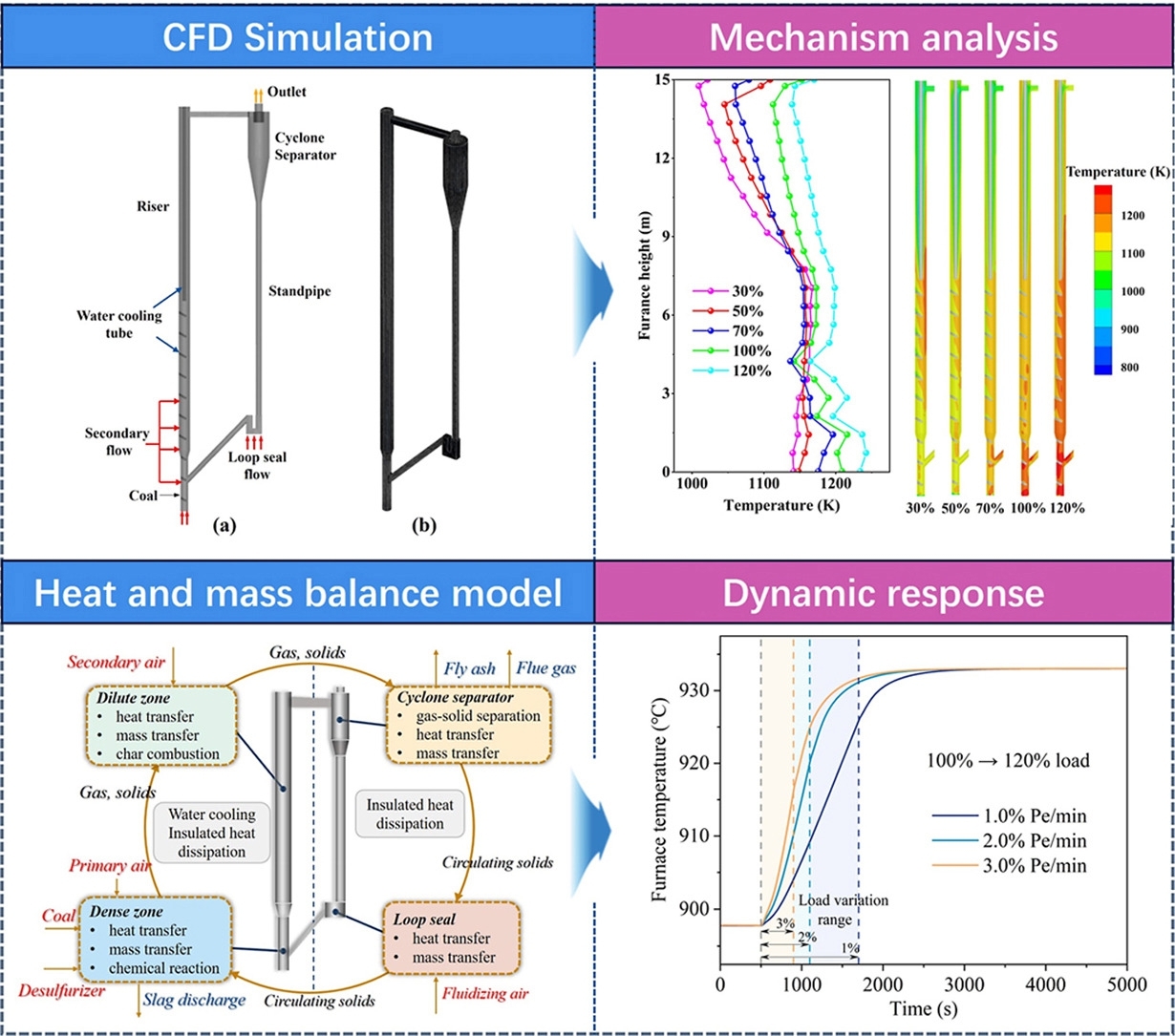
With large-scale integration of renewable energy into the grid, conventional coal-fired units are shifting toward deep peak-regulation. Oxy-fuel combustion circulating fluidized beds (CFB) offer low pollution and high carbon-capture potential, but their large thermal inertia and complex load-change mechanisms limit peak-regulation flexibility. In this study, a MW-scale oxy-fuel CFB pilot plant is modeled using a two-level approach: computational fluid dynamics (CFD) for detailed mechanisms and a heat and mass balance (HMB) model for system dynamics. The wide-load operation from 30% to 120% is investigated. Results show that during load reduction, the fluidization regime transitions from fast to bubbling bed. At 30% load, the dilute zone temperature drops by 72 K compared with 100% load, and the axial temperature difference increases. NO emission reaches its highest value of 70.2 mg/MJ at 70% load. The load change rate affects system stability. During load increase, the CO2 concentration in the flue gas first decreases and then increases. With a load increase rate of 3% Pe/min, the disturbance amplitude of CO2 is 1.58%, while during load reduction it reaches 3.14%. This study provides a theoretical reference for safe and stable operation of oxy-fuel combustion CFB boilers under deep peak-regulation.
Graphical abstract
Keywords
Oxy-fuel combustion; Circulating fluidized bed; Load variation; Numerical simulation; Dynamic modeling
文章导读