
Volume 118
Effects of particle morphology and contact curvature on particle breakage behaviour (Open Access)
Bin Zhang a, Joana Fonseca b, Sadegh Nadimi a *
a School of Engineering, Newcastle University, Newcastle upon Tyne, NE1 7RU, UK
b Department of Civil Engineering, City St George’s, University of London, London, EC1V 0HB, UK
10.1016/j.partic.2026.09.006
Volume 118,
November 2026,
Pages 391-407
Received 14 April 2026, Revised 10 September 2026, Accepted 11 September 2026, Available online 12 September 2026, Version of Record 24 September 2026.
E-mail:
sadegh.nadimi-shahraki@ncl.ac.uk
Highlights
• Particle shape controls fracture force variability and strength estimation.
• μFE model with CIEs accurately simulates particle breakage mechanisms.
• New method normalises fracture force by contact area for consistency in strength measurement.
• Normalised contact area converges across indenter sizes despite variations.
• Smaller indenters cause splitting; larger ones promote chipping behaviour.
Abstract
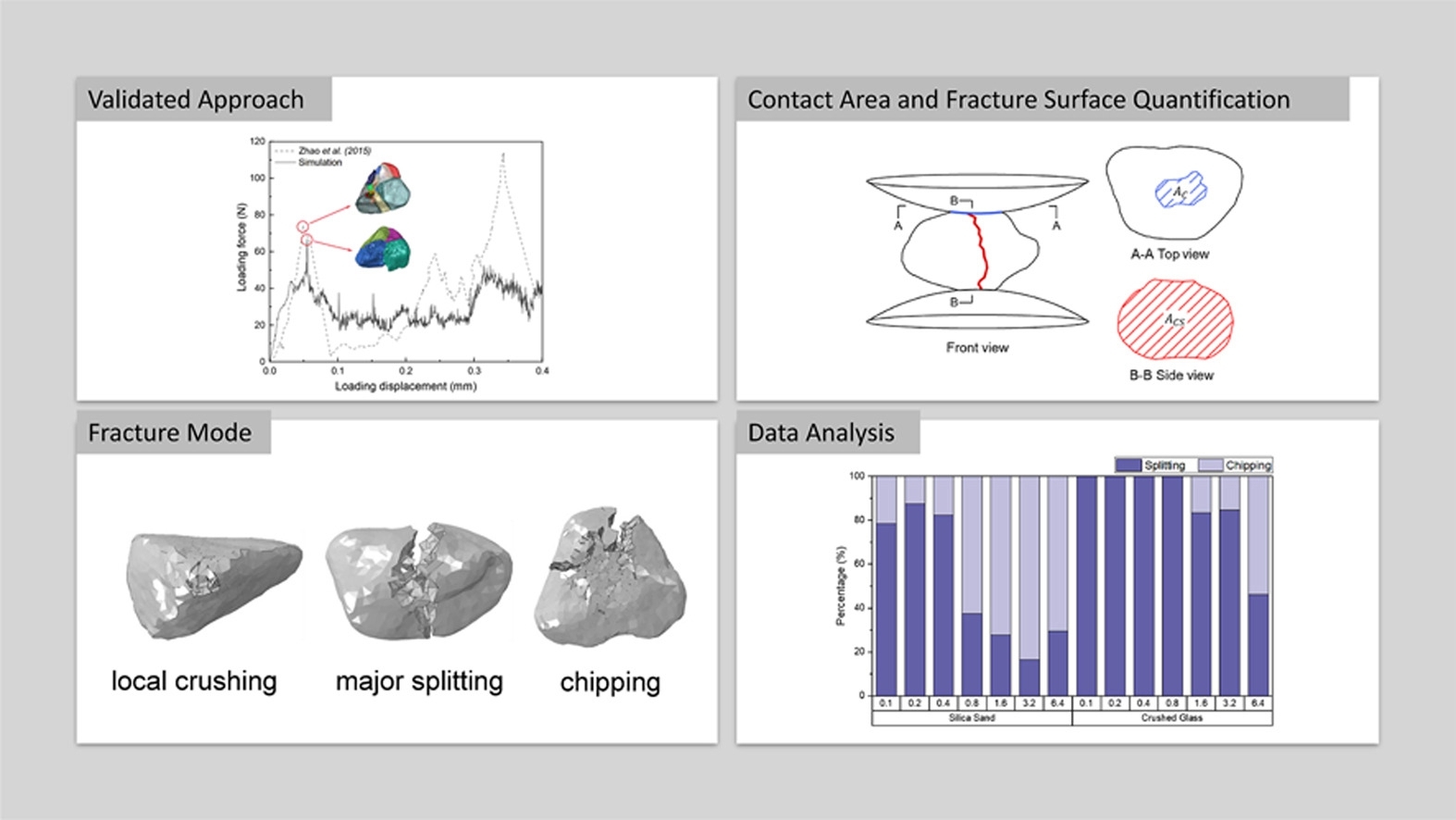
Understanding the particle strength is crucial for improving the efficiency, sustainability, and overall performance of processes involving particle breakage. While extensive laboratory testing has provided valuable insights, a consistent method for estimating tensile strength remains elusive. This challenge arises primarily from the complex interplay between geometric and material anisotropy, as well as the inherent heterogeneity of particles, which complicates the standardisation and reproducibility of testing procedures. In this contribution, a point loading test with varying indenter sizes is employed to investigate the effect of contact area on particle tensile strength. A micro finite element (μFE) model is employed to capture the morphology (i.e. shape and size) of real granular materials, incorporating cohesive interface elements to simulate particle breakage. It is observed that the normalised contact area remains independent of indenter size, which motivates the introduction of a correction factor to reconcile variations in tensile strength estimate for the same particle tested with different indenters. The influence of contact area on crushing force, morphological characteristics, indenter size, and fracture mode is systematically analysed. This study provides a framework for optimising tensile strength measurements, which are challenging to achieve through experimental methods alone, and underscores the advantages of the μFE approach in geotechnical research.
Graphical abstract
Keywords
Particle-scale behaviour; Particle tensile strength; Numerical modelling; Fabric/structure of soils; Sands
文章导读