
Volume 118
Development of two-marker and three-marker mesoscale heat-transfer closures for gas-solid flows from filtered CFD-DEM data
Yu Li a, Zhao Duan a, Qiuyu Sun a, Simeng Cheng a, Teng Dong a, Sen Han b *
a Shaanxi Provincial Key Laboratory of New Transportation Energy and Automotive Energy Saving, School of Energy and Electrical Engineering, Chang'an University, Xi'an, 710064, China
b School of Civil Aviation, Xihang University, Xi'an, 710077, China
10.1016/j.partic.2026.09.010
Volume 118,
November 2026,
Pages 408-415
Received 29 June 2026, Revised 13 September 2026, Accepted 16 September 2026, Available online 16 September 2026, Version of Record 24 September 2026.
E-mail:
963864026@qq.com; hansen@xaau.edu.cn
Highlights
• Two filtered heat transfer closures are established based on spatial filtering of fine-grid CFD-DEM heat-source datasets.
• The two-marker model correlates heat transfer correction factor Q with filter size and filtered solid volume fraction.
• The three-marker model introduces dimensionless filtered gas-solid temperature difference as an extra marker.
• A priori and a posteriori analysis verified the validity of the proposed model.
• The developed models are applicable to coarse-grid gas-solid flow simulations with filter sizes below 40dp.
Abstract
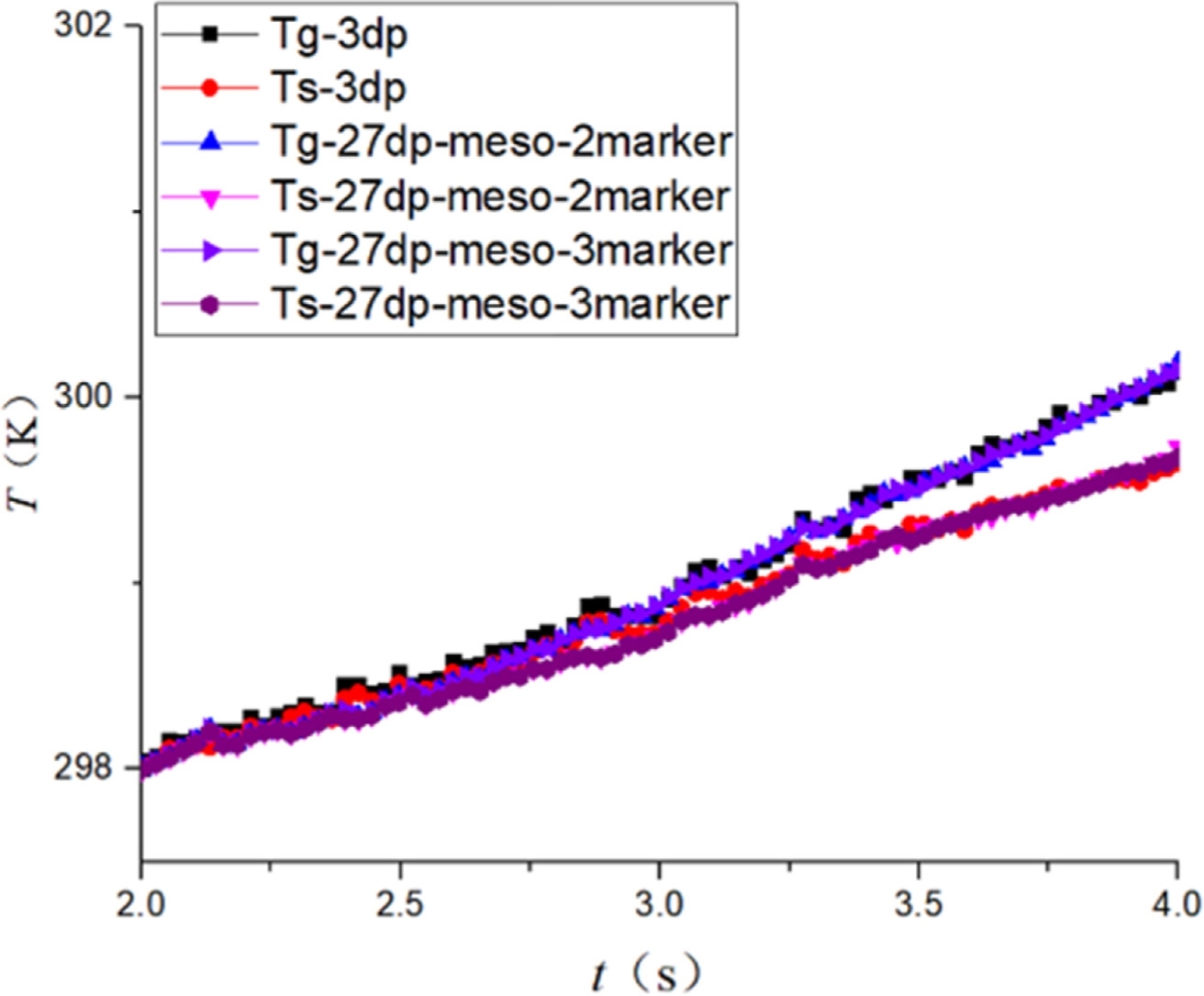
When conducting numerical simulations of large-scale industrial reactors using coarse-grid and coarse-grained methods, there is an urgent need for accurate, user-friendly, and mesoscale heterogeneity-characterizing gas-solid interphase heat transfer models. This work applies the CFD-DEM to investigate the interphase thermal exchange behavior within gas-solid two-phase systems. Sufficient statistical samples are obtained by introducing heat sources into both gas and solid phases to maintain the interphase temperature difference. Spatial filtering is applied to the CFD-DEM simulation data, and two-marker and three-marker mesoscale models suitable for the filtered interphase heat transfer coefficient are proposed. For the two-marker formulation, the filtered coefficient for interphase heat transfer depends exclusively on two quantities: the filter size and the filtered solid volume fraction, while the three-marker model additionally incorporates the dimensionless filtered gas-solid temperature difference as a characteristic scalar. A priori analysis results demonstrate that the proposed three-marker model outperforms the two-marker model in predictive performance, and both models are superior to existing literature models. A posteriori coarse-grid CFD-DEM simulations under an independent operating condition further confirm the improved accuracy of the proposed closure, indicating promising generalization of the present models. This series of models is applicable for gas-solid interphase heat transfer calculations with grid sizes smaller than 40 times the particle diameter under the tested conditions. Broader-range engineering-oriented validation remains required for real-world industrial deployment.
Graphical abstract
Keywords
Mesoscale modeling; Gas-solid two-phase flow; Interphase heat transfer; Computational fluid dynamics-discrete element method (CFD-DEM); Spatial filtering method
文章导读